
Release Notes
This listing is also for 1756-EN4TRXT.
Version 3.001 (released 4/2020)
Catalog Number 1756-EN4TR (series A)
Requirements
This release has the following requirements.
Features
This release includes the following system features.
- Catalog Numbers: 1756-EN4TR, 1756-EN4TRK, 1756-EN4TRXT
Corrected Anomalies in This Release
This release corrects the following anomalies.
Catalog Numbers:
- 1756-EN4TR, 1756-EN4TRK, 1756-EN4TRXT
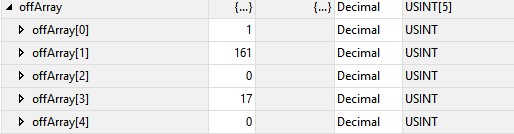
1756-EN4TR cannot be configured to appear in SNMP scan (Lgx00229065)
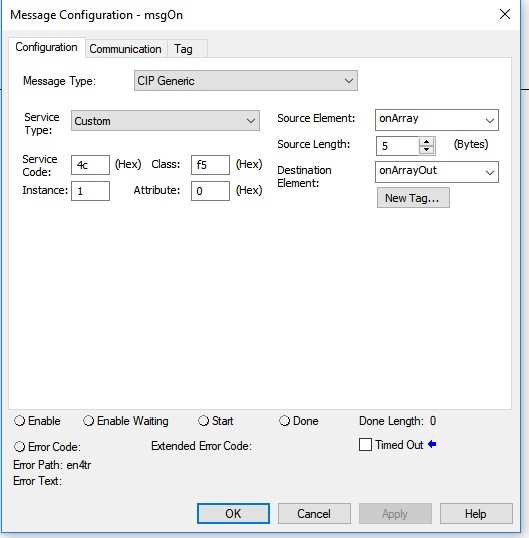
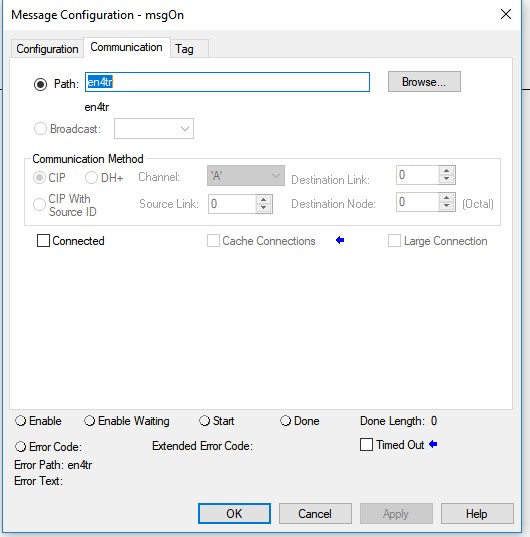
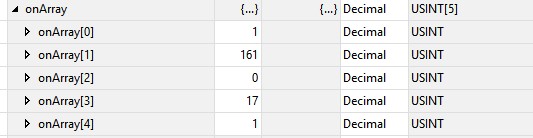
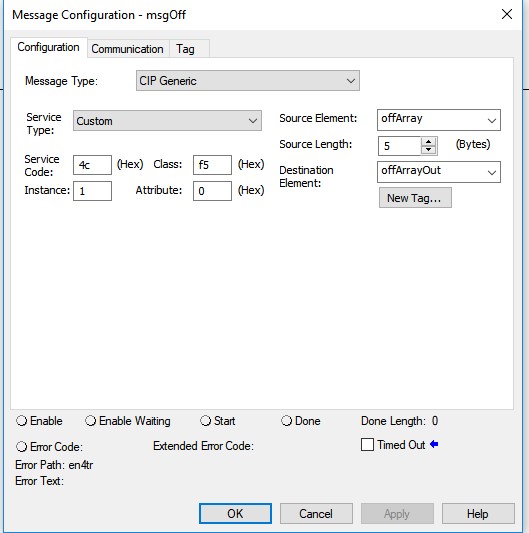
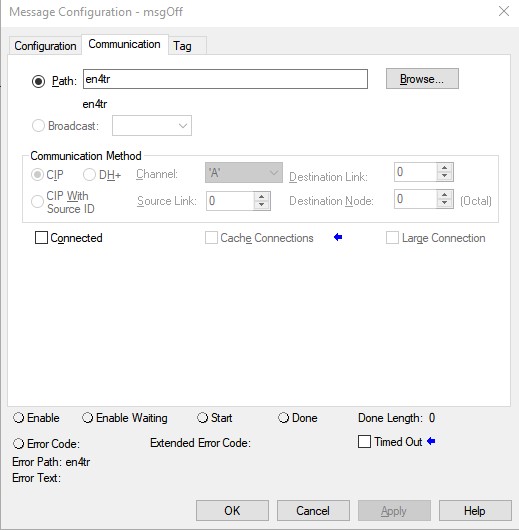
Content of offArray must be:
There are two additional tables to store result of IANA port admin state change operation.

Known Anomalies in This Release
This release has the following known anomalies.
Listen Only Disruptions when in Redundant Adapter Mode (Lgx00232454, Lgx00232604, Lgx00232589)
Known Anomaly First Identified as of Firmware Revision 3.001
Catalog Numbers: 1756-EN4TR, 1756-EN4TRK, 1756-EN4TRXT
In a bridged multicast connection (not rack-optimized) "Listen-only" (one PLC with a normal connection, and a second with "listen only"):
- after a switch-over, the entire multicast connection gets closed
In rack-optimized connections where a "listen-only" connection is used (one PLC with normal connection, and a second with "listen only"):
- in secondary, after cable break and reconnect secondary ASSERTS
- in secondary, after disqualification, secondary ASSERTS
CIP Security Configuration Not Retained on Power Cycle with SD Card Slot Reconfigured (Lgx00232273)
Known Anomaly First Identified as of Firmware Revision 3.001
Catalog Numbers: 1756-EN4TR, 1756-EN4TRK, 1756-EN4TRXT
If the SD Card slot was configured to be disabled, and then configured again to enabled state, the CIP Security configuration is lost after power-cycling the chassis. If the SD Card slot was configured only once to be disabled, and no further re-configurations were made, then CIP Security configuration is still applied.
Workarounds:
- Leave the SD Card slot in the default state (enabled) and do not change it in Studio 5000.
- Configure the SD Card slot to be disabled in Studio 5000 and do not attempt to reconfigure it later.
- If the reconfiguration of the SD Card slot to the enabled state is needed, immediately insert or replace an empty SD Card before the power-cycle for the device do a full backup of the configuration files to the SD Card.
Removing Security Policy Can Result in Lost Access to the EtherNet/IP Communication Module (00233815)
Known Anomaly First Identified as of Firmware Revision 3.001
Catalog Numbers: 1756-EN4TR
Double Cable Break on Secondary Adapter Can Lead to Longer Qualification Times
|
Communication Modules
|
First Known in Firmware
Revision
|
Corrected in Firmware
Revision
|
|
1756-EN4TR, 1756-EN4TRK,
1756-EN4TRXT |
3.001
|
—
|
When two 1756-EN4TR modules are used in remote chassis as a redundant adapter pair, and there are double-cable breaks on the secondary adapter, requalification can take a long time after the cables are reinserted.
Known Anomalies from Previous Releases
These anomalies are from previous releases but are still known in this release.
|
Device
|
First Known in
Firmware Revision
|
Corrected in Firmware Revision
|
|
CompactLogix® 5380
|
28.011
|
34.014, 35.013, 36.011 and later
|
|
Compact GuardLogix® 5380 SIL 2
|
31.011
|
34.014, 35.013, 36.011 and later
|
|
Compact GuardLogix 5380 SIL 3
|
32.013
|
34.014, 35.013, 36.011 and later
|
|
CompactLogix 5380 Process
|
33.011
|
34.014, 35.013, 36.011 and later
|
|
CompactLogix 5480
|
32.011
|
34.014, 35.013, 36.011 and later
|
|
ControlLogix® 5580
|
28.011
|
34.014, 35.013, 36.011 and later
|
|
GuardLogix 5580
|
31.011
|
34.014, 35.013, 36.011 and later
|
|
ControlLogix 5580 Process
|
33.011
|
34.014, 35.013, 36.011 and later
|
|
1756-EN4TR
|
2.001
|
6.001 and later
|
|
1756-EN3TR/B, 1756-EN2TR/C
|
10.007
|
12.001 and later
|
|
1756-EN2TP
|
10.020
|
12.001 and later
|
|
1756-EN2T/D
|
10.006
|
12.001 and later
|
|
1756-EN2F/C
|
10.009
|
12.001 and later
|
Rack-optimized Connections Can Cause an Ethernet Module to Assert (1186272, 1186282, 942336)
|
Communication Modules
|
First Known in Firmware Revision
|
Corrected in Firmware Revision
|
|
1756-EN2T, 1756-EN2TR
|
10.007
|
12.001 and later
|
|
1756-EN3TR
|
10.007
|
12.001 and later
|
|
1756-EN4TR,
1756-EN4TRK,
1756-EN4TRXT |
2.001
|
4.001
|
Five or more rack-optimized connections that are targeted to an Ethernet module cause the module to assert immediately. The module status display shows ‘RackInput.cpp LineXXX’ information in the assert message.
1756-EN4TR May Not Switchover After Reconnection
|
Communication Modules
|
First Known in Firmware
Revision
|
Corrected in Firmware
Revision
|
|
1756-EN4TR, 1756-EN4TRK,
1756-EN4TRXT |
2.001
|
—
|
After both primary and secondary 1756-EN4TR modules are disconnected from the network, the redundant chassis pair may not switchover after the previously secondary module is reconnected to the network.
If this issue occurs, then manually reset the primary chassis.
Simultaneous Listen-Only and Rack-optimized Connections to the Same Module Can Lead To I/O Fault
|
Communication Modules
|
First Known in Firmware
Revision
|
Corrected in Firmware
Revision
|
|
1756-EN4TR, 1756-EN4TRK,
1756-EN4TRXT |
2.001
|
—
|
If two controllers connect to the same I/O module through a 1756-EN4TR module, an I/O fault can occur if one controller uses listen-only connections and the other controller uses rack-optimized connections.
The controller that uses listen-only connections displays a Module Fault: (Code 0x0203) Connection Timed Out.
Cannot Update 1756-EN4TR Using Firmware Supervisor
|
Communication Modules
|
First Known in Firmware
Revision
|
Corrected in Firmware
Revision
|
|
1756-EN4TR, 1756-EN4TRK,
1756-EN4TRXT |
2.001
|
—
|
If a Studio 5000 Logix Designer® application project with a ControlLogix® 5580 controller and a 1756-EN4TR module is saved to the SD card with the device firmware, then the ControlLogix 5580 controller cannot restore the firmware to the 1756-EN4TR module using Firmware Supervisor if the 1756-EN4TR module goes into safe boot.
While this occurs infrequently, if this happens, then use ControlFLASH™ or ControlFLASH Plus™ software to upgrade the 1756-EN4TR
Sent Bytes Per Second Displays a Larger Incorrect Value (1548181)
|
Controllers and Communication Modules
|
First Known in
Firmware Revision
|
Corrected in Firmware
Revision
|
|
CompactLogix™ 5380
|
28.011
|
35.011 and later
|
|
Compact GuardLogix® 5380 SIL 2
|
31.011
|
35.011 and later
|
|
Compact GuardLogix 5380 SIL 3
|
32.013
|
35.011 and later
|
|
CompactLogix 5380 Process
|
33.011
|
35.011 and later
|
|
CompactLogix 5480
|
32.011
|
35.011 and later
|
|
ControlLogix® 5580
|
28.011
|
35.011 and later
|
|
GuardLogix 5580
|
31.011
|
35.011 and later
|
|
ControlLogix 5580 Process
|
33.011
|
35.011 and later
|
|
1756-EN4TR, 1756-EN4TRK, 1756-EN4TRXT
|
2.01
|
5.001 and later
|
Under HMI/MSG Connected (EtherNet/IP Port) on the device Diagnostic webpages, Sent Bytes Per Second displays a much larger incorrect value, not the actual sent bytes per second.
Cannot Disable the Socket Object on 1756-EN4TR With a MSG Instruction (1804575)
|
Communication Modules
|
First Known in Firmware
Revision
|
Corrected in Firmware
Revision
|
|
1756-EN4TR, 1756-EN4TRK,
1756-EN4TRXT |
2.001
|
5.001
|
When using a MSG instruction to disable the socket object on a 1756-EN4TR module, setting Attribute 9 to a source element value of 0 does not disable the socket object.
Application Notes
This release has the following application notes.
New Firmware Updates Can Impact the Performance of Message Rate Capacity HMI/MSG (Class 3) Data
Each new major revision of the controller/communication module firmware provides additional features and functionality, but this consumes additional processing power from the module even if the features are not utilized. This manifests as degrading HMI/messaging performance for the respective module.
Despite this degradation, the specifications defined for the respective modules have been maintained:
|
Module
|
Message Rate Across the Embedded Ethernet Port
|
|
ControlLogix® 5580
CompactLogix® 5380 |
2000 MSG/sec
|
|
GuardLogix® 5580 controllers in a SIL3 configuration
Compact GuardLogix 5380 SIL3 controllers |
1000 MSG/sec
|
|
1756-EN4TR Ethernet modules
|
3700 MSGs/sec
|
To improve the messaging capacity, it is recommended to employ the following:
- For high-frequency messaging, utilize connected cached messages
- Utilize message reads as opposed to message writes; they’re more efficient
- For ControlLogix 5580 controllers, route HMI/messages through communication modules in the chassis as
opposed to going directly to the embedded port of the controller
- Offloading some of the processing to the communications module results in greater messaging capacity than using the front port alone
- This recommendation does not apply to I/O or produce/consume data, it is more efficient and there is more capacity for that data to route through the embedded port of the controller
- Upgrade to a 5590 controller
- The HMI/messaging messaging capacity is doubled through the embedded ethernet port
For more information, see these publications:
- ControlLogix and GuardLogix Controller Specifications Technical Data, publication 1756-TD001
- CompactLogix 5380, Compact GuardLogix 5380, and CompactLogix 5480 Controllers Specifications Technical Data, publication 5069-TD002
- 1756 ControlLogix Communication Modules Specifications Technical Data, publication 1756-TD003
Copyright © 2026 Rockwell Automation, Inc. All rights reserved.
Rockwell Automation, Allen-Bradley, and FactoryTalk are trademarks of Rockwell Automation, Inc.
To view a complete list of Rockwell Automation trademarks please click here.
Trademarks not belonging to Rockwell Automation are property of their respective companies.