
Release Notes
(9355-WABx) RSLinx® Classic permits 3rd-party software to access Rockwell Automation controllers using OPC DA and DDE.
Version 3.90.01 (released 9/2017)
Catalog Number RSLinx Classic
Requirements
This release has the following requirements.
RSLinx Classic works within the system requirements of all Rockwell Automation® software products.
For the latest compatibility and driver support information, refer to the Rockwell Automation Product Compatibility and Download Center .
Hardware requirements
RSLinx Classic requires the following hardware:
- Intel® Core 2 Duo, 2.8 Ghz processor; 2 GB of memory
- At least 2.2 GB of available hard drive space; more hard disk space may be required for specific application features.
- A 16-color, SVGA display with 800 by 600 or greater resolution.
- A mouse or other Windows-compatible pointing device.
- An Ethernet card and/or Allen-Bradley communications device or cable.
Software requirements
Operating systems
RSLinx Classic is tested on operating systems installed from original Microsoft® media only. RSLinx Classic runs on either the 32-bit or 64-bit versions of the following Windows® operating systems:
- Windows 7 Enterprise with Service Pack 1
- Windows Embedded Standard 7 with Service Pack 1
- Windows 7 Home Premium with Service Pack 1
- Windows 7 Ultimate with Service Pack 1
- Windows 7 Professional with Service Pack 1
- Windows 8
- Windows 8 Enterprise
- Windows 8 Professional
- Windows 8.1
- Windows 8.1 Enterprise
- Windows 8.1 Professional
- Windows 10 Enterprise*
- Windows 10 Professional*
- Windows 10 IoT Enterprise 2016 Long Term Servicing Branch (LTSB) Embedded**
- Windows Server® 2008 R2 Enterprise Edition with Service Pack 1
- Windows Server 2008 R2 Standard Edition with Service Pack 1
- Windows Server 2012 Standard
- Windows Server 2012 Datacenter
- Windows Server 2012 R2 Standard
- Windows Server 2012 R2 Datacenter
- Windows Server 2016 Standard*
- Windows Server 2016 Datacenter*
*See Operating systems section of Anomalies for notes regarding Windows 10 and Windows Server 2016 support.
**Supported with the Allen-Bradley 61xx family of Industrial Computers or CompactLogix™ 5480 family of controllers.
Software compatibility
RSLinx Classic version 3.90.01 (CPR 9 SR 9) has been tested, and is compatible, with the following products:
- Studio 5000 Logix Designer version 30.00.00 or earlier
- FactoryTalk View version 9.00.00
- FactoryTalk Services Platform version 2.90.00
- FactoryTalk® Activation Manager version 4.00.02
RSLinx Classic version 3.90.01, Studio 5000 Logix Designer version 30.00.00, and device profiles that ship with Studio 5000 Logix Designer version 30.00.00 are not compatible with RSNetWorx version 9.00.00 or earlier. RSNetWorx and the DeviceNet Tag Generator must be upgraded to a version later than 9.00.00 prior to installing these products.
Features
This release includes the following system features.
RSLinx Classic version 3.90.01 has the following system features and enhanced features:
Enhanced features
- New operating system support
- Windows Server 2016 Standard
- Windows Server 2016 Datacenter
- EDS file updates The EDS files for some devices have been added or updated in this release. This includes support for new hardware devices, such as CompactLogix 5480 controllers.
Corrected Anomalies in This Release
This release corrects the following anomalies.
- RSLinx Classic may shut down when topics reference invalid or empty internal memory locations. First identified in RSLinx Classic version 2.55.00. [364725, 365088, 365089, 364866, 365174] In this release, RSLinx Classic runs normally upon the same operation.
- RSLinx Classic may shut down when referencing invalid tag address. First identified in RSLinx Classic version 2.59.00. [364949] In this release, RSLinx Classic runs normally upon the same operation.
- RSLinx Classic may shut down if there is a large number of OPC server connections. First identified in RSLinx Classic version 3.60.00. [364865] In this release, RSLinx Classic runs normally upon the same operation.
- RSLinx Classic may shut down when OPC clients are browsing topics which contain offline files. First identified in RSLinx Classic version 3.60.00. [364238] In this release, RSLinx Classic runs normally upon the same operation.
- RSLinx Classic may stop responding if unsolicited messages are received from controllers during shutdown. First identified in RSLinx Classic version 3.60.00. [365040] In this release, RSLinx Classic runs normally upon the same operation.
- RSLinx Classic may fail to browse or communicate with 1756-EN2T devices after running for several days. First identified in RSLinx Classic version 3.60.00. [276289] In this release, RSLinx Classic communicates with 1756-EN2T devices normally upon the same operation.
- RSLinx Classic version 3.90.00 personalized license cannot activate the software. The software shows as RSLinx Classic Lite. First identified in RSLinx Classic version 3.90.00. [364730] In this release, RSLinx Classic is activated normally with personalized licenses.
- When a controller’s USB cable is unplugged from a computer running RSLinx Classic, the USB CIP driver may not respond or respond slowly. The device shortcut may still exists in RSLinx Classic, and the Rockwell Automation USB CIP Device still exists in the Windows Device Manager. First identified in RSLinx Classic version 3.90.00. [365636] In this release, the USB CIP driver responds normally upon the same operation.
- RSLinx Classic may shut down with invalid parameters when RSLinx Classic establishes connection to controllers. First identified in RSLinx Classic version 3.60.00. [364948] In this release, RSLinx Classic runs normally upon the same operation.
- RSLinx Classic may stop responding during shutdown. First identified in RSLinx Classic version 2.59.00. [365385, 365730] In this release, RSLinx Classic runs normally upon the same operation.
- RSLinx Classic may shut down when establishing TCP connections. First identified in RSLinx Classic version 2.59.00. [365384] In this release, RSLinx Classic runs normally upon the same operation.
- RSLinx Classic may stop responding due to unidentified reasons. First identified in RSLinx Classic version 3.60.00. [365962] In this release, RSLinx Classic runs normally.
- RSLinx Classic may shut down when clicking the Help button on the configuration page of TCP driver. First identified in RSLinx Classic version 2.55.00. [365994] In this release, RSLinx Classic runs normally upon the same operation.
- RSLinx Classic threads may stop responding due to the incorrect elements in the queue. First identified in RSLinx Classic version 2.55.00. [365995] In this release, RSLinx Classic threads runs normally.
- RSLinx Classic may shut down when writing to a UDT item (String type) which contains no elements. First identified in RSLinx Classic version 3.80.00. [365558]
- After reparing RSLinx Classic installation in Windows Control Panel, the MSI install dialog box shows when launching RSLinx Classic. First identified in RSLinx Classic version 3.90.00. [365744] In this release, the MSI install dialog box does not show when launching RSLinx Classic.
- The FactoryTalk Batch Server may stop response every a few hours because more than 700 OPC server objects exist in OPC connections. First identified using FactoryTalk Batch version 12.01.00 and RSLinx Classic version 3.90.00. [365744] In this release, FactoryTalk Batch Server runs normally.
- After RSLinx Classic re-install the missing components, ControlFLASH may fail to launch RSLinx Classic from ControlFLASH Welcome page. First identified using RSLinx Classic version 3.90.00 and ControlFLASH version 14.01.00. [364983] In this release, ControlFLASH launches RSLinx Classic normally from the Welcome page.
- FactoryTalk Batch Server may stop responding if you shut down the Batch Server process and reboot the Batch Server. First identified using FactoryTalk Batch version 12.01.00 and RSLinx Classic version 3.90.00. [365555] In this release, FactoryTalk Batch Server runs normally.
Known Anomalies in This Release
This release has the following known anomalies.
The following are the known anomalies for RSLinx Classic version 3.90.01.
1770-KFC device
- RSLinx Classic version 2.42.00 or later fails to browse remote ControlLogix controllers under 1770-KFC15 DF1 passthrough. First identified in RSLinx Classic version 2.42.00. [354274]
There is currently no work around for this anomaly. To communicate with a 1770-KFC15 module via DF1 protocol, use RSLinx Classic version 2.41.00 or earlier.
EtherNet and EtherNet/IP
- Devices on previous subnet are not removed after configuration changes. If an EtherNet/IP driver's configuration is changed to a new remote Ethernet subnet, the devices browsed on previous Ethernet subnet were not removed. First identified in RSLinx Classic version 3.51.00. [273876]
There is currently no work around for this anomaly.
EDS file upload and registration
- RSWho cannot upload and register EDS files with path length more than 256 bytes. For an online device whose path length exceeds 256 bytes, RSWho cannot upload and register the EDS file of the device, neither automatically nor manually. First identified in RSLinx Classic version 3.80.00. [357201]
To work around this problem, change the location where the computer is connected, so that the path length of the device is less than 256 bytes.
Operating systems
- When running RSLinx Classic on Windows 10 Professional or Enterprise v1607 operating systems, initiating a network connectivity break by disabling NIC adaptors in Device Manager can cause application failures requiring a restart of the application. This issue was introduced in the Windows 10 v1607 feature build. [363223] To avoid this problem, run the Microsoft Hotfix outlined in Answer ID 964391 in the Rockwell Automation Knowledgebase. This hotfix will be released in the December 2016 or January 2017 Windows Update pack. Alternatively, you can run Windows 10 v1511 where this issue is not present.
- Because of the timing of the RSLinx Classic version 3.90.00 release, RSLinx Classic is not fully qualified to run on Windows Server 2016 operating systems. While RSLinx Classic version 3.90.00 does not prevent installation on Windows Server 2016 operating systems, additional changes may be required in order to function properly. [363223]
- RSLinx Classic version 3.90.00 is not tested to run on Windows Embedded 8.1 Industry Professional operating system, while RSLinx Classic does not prevent installation on this operating systems. Additional changes may be required in order to function properly. First identified in RSLinx Classic version 3.90.00. [363223] To avoid this problem, use another supported operating system that is listed in the System requirements topic.
RSLinx Gateway
- From a client, you cannot browse the Remote Devices via RSLinx Classic Gateway driver, which was configured on a RSLinx Classic Gateway server. First identified in RSLinx Classic version 2.31.00. [21836]
Stratix
- RSLinx Classic may stop responding when viewing the module statistics of Stratix 5410 switches on the Port Diagnostics tab. First identified in RSLinx Classic version 3.74.00. [355521]
Known Anomalies from Previous Releases
These anomalies are from previous releases but are still known in this release.
- RSLinx Classic may exit if click Cancel button when adding a SLC 500 (DH485) Emulator driver. When adding a SLC 500 (DH485) Emulator driver in RSLinx Classic, if you click Cancel on the Configure SLC 500 (DH485) Emulator Driver dialog box, RSLinx Classic may exit unexpectedly on Windows 7 operating systems. First identified in RSLinx Classic version 2.57.00. [269134]
There is currently no work around for this anomaly.
- RSWho may fail to upload and register all the EDS files from unregistered devices, if there are too many EDS files (for example, 400 files) or multiple RSWho instances (for example, 5 instances). First identified in RSLinx Classic version 3.80.00. [357152] To work around this problem, upload and register several EDS files (for example, 10 files) with a single RSWho instance each time, or manually upload and register the EDS files using the EDS Hardware Installation Tool.
- If an EDS file is removed using the EDS Hardware Installation Tool while RSLinx Classic is running, the EDS file cannot be uploaded and registered in the RSWho, neither automatically nor manually. First identified in RSLinx Classic version 3.80.00. [357375] To solve this problem, restart RSLinx Classic to upload and register the EDS file (either automatically or manually).
- FactoryTalk View Studio startup performance tends to degrade over time when there are a large number of devices on the network. First identified in RSLinx Classic version 2.56.00. [218691] To solve this problem, compact existing harmony topologies through RSLinx Classic:
- In RSLinx Classic menu bar, click File > Compact Harmony, or
- In RSLinx Classic Launch Control Panel, click Tools > Compact Harmony.
Functional Changes
This release has the following functional changes from the previous release.
RSLinx Classic version 3.90.01 has the following changes in functionality since the last release:
EDS file updates
The EDS files for some devices have been added or updated in this release. This includes support for new hardware devices. For more detailed information, refer to Rockwell Knowledgebase Answer ID 58981 .
x64 driver package
RSLinx Classic version 3.90.01 (CPR 9 SR 9) x64 driver package includes updates to the following drivers:
- 1747-UIC (DH485)
- 1752-SmartGuard USB
- 1784-PCIC(S) (ControlNet)
- 1784-PKTCS (ControlNet)
- 1784-PKTX (DH485 / DH+ / RIO)
- 1784-U2DHP (DH+)
- Micro800 Remote LCD (208-REMLCD / 820 Remote LCD)
- Micro810
- Virtual Backplane
- USB CIP
In addition, this release of x64 driver package includes a number of enhancements, including USB CIP driver improvements and new driver installation folder C:\Program Files\Rockwell Automation.
Application Notes
This release has the following application notes.
The following are the application notes for RSLinx Classic version 3.90.01.
Backup and restore
- When you run the Backup/Restore utility, the Restart RSLinx Classic when finished check box is not available on the Shutdown RSLinx Classic dialog box.
DDE/OPC
- To receive unsolicited DDE messages from a processor through a DHRIO module, and through an ENET module over an Ethernet network:
- Select your DDE topic from the DDE/OPC Topic Configuration dialog box.
- Select Advanced Communication and click Remote.
- Manually enter the Remote Link ID of the DHRIO channel through which the message is being sent.
- Newly created DDE topics default to 20 for the Limit Maximum Packets. This makes the updates more symmetrical for the group of optimized packets for each topic. For the same functionality on older DDE topics, set the Limit Maximum Packets on the DDE/OPC Topic Configuration dialog box, Data Collection tab to 20, or the best value for the PLC and access method.
- When configuring DDE/OPC topics to receive unsolicited messages from a ControlNet device, from the DDE/OPC Topic Configuration dialog box, select the Advanced Communication tab and select Local route for Local or Remote Addressing.
- When setting up a DDE topic to a remote processor via ControlLogix Gateway, ensure that unsolicited messages coming to RSLinx Classic to work properly by setting the Remote Link ID to match the Link ID of the remote module (such as DHRIO).
DF1 driver
- The DF1 Polling Master Driver and DF1 Slave Driver do not support hardware handshaking control.
DH+ and DH485
- You cannot download data to a Standard PanelView on a DH+ network if your computer is connected to the Standard Panel View via RSLinx Classic > EtherNet > 1756-ENBT Backplane > 1756-DHRIO > DH+ network path.
- RSLinx Classic does not support DH connected to a 1770-KF2.
- Duplicate nodes are not detected when configuring a 1784-KT(D) card. When configuring a 1784-KT(D) card, use a station address that is not in use by another device.
- The 1770-KF2 and 1770-KF3 do not support offlink messages. Therefore, when using these devices, you cannot browse through bridges such as 1785-KA, 1785-KA5, or 1756-DHRIO.
- When using auto configuration on a 1770-KF2 or1770-KF3 device, you must set the Station Number to that of the 1770-KF2 or1770-KF3 device before clicking Auto-Configure. Otherwise, Auto-Configure tries to detect the device at the currently selected station, and if the device is a PLC, Auto-Configure configures to the PLC rather than the 1770-KF2 or1770-KF3 device.
- If the 1784-PCMK driver is a duplicate node, all stations in the RSWho appear as a question mark with a red X.
- Since both channels of a PKTXD card share the same interrupt, you cannot configure one channel for SoftLogix 5 and the other for RSLinx Classic. You can configure RSLinx Classic and SoftLogix 5 to use separate PKTX(D) cards.
- If you plug in your DH-485 UIC device on a computer running a Windows or Windows Server operating system, and the computer has already installed the 1752-L24BBB SmartGuard controller, the DH-485 UIC device will not be recognized by the Plug and Play feature. To solve the problem, follow these steps:
- Press Windows and R on your keyboard to open the Run dialog box.
- Type devmgmt.msc and click OK to open the Device Manager.
- In the Device Manager window, expand the Universal Serial Bus controllers tree.
- You will see an entry for FTDI FT8U2xx Device. Right-click it, and click Properties.
- On the Driver tab, click the Update driver button.
- If you change the Station Number (node address) of a DH-485 UIC device without first removing or re-installing the device, the device will stop functioning. If you want to change the Station Number, you must re-install the DH-485 UIC device, and then use the Configure UIC devices dialog box to set the Station Number.
Driver certificate
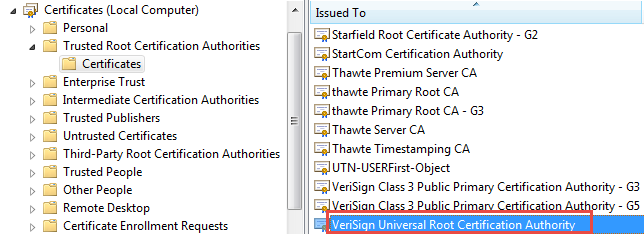
- Computers running Windows that are not connected to the internet may not verify some of the RSLinx Classic files. This is because the root certificate is not present on the local machine.
- To correct this issue, the RSLinx Classic installation process adds a certificate verisign-univ.cer issued by VeriSign Universal Root Certification Authority to the Trusted Root Certification Authorities store for a local computer.
- This certificate can be found in the Console Root > Certificates (Local Computer) > Trusted Root Certification Authorities > Certificates folder of the Windows Microsoft Management Console MMC.EXE tool’s certificates Snap-in option.
EtherNet and EtherNet/IP
- EtherNet/IP driver cannot recognize PLC5 and SLC devices when using Remote subnet.
- RSLinx Classic cannot listen to unsolicited message as the Ethernet Port listening function is disabled by default. To enable the function, click DDE/OPC > Options... > General, and select Accept UDP Messages on Ethernet Port.
FactoryTalk Activation Manager
- If you have disconnected one of the servers used for activation from the network, RSLinx Classic may stop responding for up to two minutes during startup, as it checks the remote server for an activation file.
To work around this, go to Find Available Activations in FactoryTalk Activation Manager, select Update Activation Search Path, and clear the check box of the disconnected server (or delete the path to the server).
Hardware considerations
- This version of RSLinx Classic does not run on Alpha, MIPS, or Power computer processors.
- Do not use the power saver option on your computer when running RSLinx Classic. Use either the BIOS or Control Panel to disable this option.
Installation
- When you uninstall RSLinx Classic, the DTL32.dll file remains in the system directory if it is locked by another application.
Module statistics
- For 1794-AENT and 1756-ENB modules, module statistics on the Port Diagnostics tab may show zeros even though the modules work properly.
No-interrupt configuration
- RSLinx Classic supports no-interrupt configurations when using Allen-Bradley network cards; however, it is recommended to assign an interrupt to increase driver performance.
OPC Foundation
- RSLinx Classic 2.55 or later does not install the automation interface wrapper rsiopcauto.dll from the OPC Foundation.
The OPC Foundation recommends using the updated automation interface wrapper, OpcDaAuto.dll, which is provided with RSLinx Classic instead of RsiOpcAuto.dll. For more detailed information, refer to Rockwell Knowledgebase Answer ID 64055.
Operating system
- RSLinx Classic is a 32-bit application. While it will function on 64-bit edition of Windows operating systems, the RSLinx Classic Single Node and OEM activations may not operate with a Windows 64-bit application running on the same computer. Windows 64-bit forces 32-bit and 64-bit applications to run in different processes which causes RSLinx Classic Single Node and OEM to see the 64-bit application as running remote and thus prevents it from using the OPC interface. In this case the system should upgrade to RSLinx Gateway to work with 64-bit applications.
Repair software
- RSLinx Classic 2.55 or later does not install the automation interface wrapper rsiopcauto.dll from the OPC Foundation.
To work around this, click OK to close the error message, and retry to repair FactoryTalk Services Platform. [276317].
RSWho browse
- RSWho with the RSLinx Classic Gateway cannot be used to go online with a processor in RSLogix 5 or RSLogix 500 software. To select a processor connected to a RSLinx Classic Gateway, configure an RSLinx Classic driver, using the Remote Devices via RSLinx or 1756-ENET Gateway driver.
Running mode
- If RSLinx Classic is running as a service, there is no graphical user interface (GUI). If you need to configure RSLinx Classic, you must be in application mode. To switch between running as a service or application, use the RSLinx Classic Launch Control Panel.
Security considerations
- Information on the security considerations related to using Rockwell Automation products can be found in the Rockwell Automation Knowledgebase, including:
Server OPC Data (Local)
- Offline browsing does not work to an .acd file on a different network machine. The .acd file must be on the local machine.
- OPC browse is not supported for .NET OPC applications.
- In Studio 5000 Logix Designer, for controllers that support External Access attribute, you can change the External Access attribute for a tag while online with the controller.
- The following scenarios may require you to restart RSLinx Classic and data clients:
- If a controller is replaced with a different controller, even if it has the same program. [265753]
- If tag attributes for tags on scan are changed and a new program is downloaded to the controller.
- If tag attributes for tags on scan are changed after an Alias Topic switch. [265756, 266168]
SLC
- When downloading a program to an SLC 500, stop all data connections active to that station. Under certain instances, the processor may fault if applications continue to poll the SLC during a download.
SmartGuard
- If you are installing a SmartGuard driver on a computer that already has RSLinx Classic installed, make sure to re-start RSLinx Classic after installing the SmartGuard driver. If you do not restart RSLinx Classic, you are not able to configure the driver.
- Although you can communicate over the DeviceNet network through the USB port of a SmartGuard device, the USB-to-DeviceNet bridging capability is limited. For example, you cannot configure 1734-ADN or 1753-DNSI modules through SmartGuard. Use another DeviceNet interface to configure these devices.
SoftLogix
- RSLinx Classic does not reread a User Defined Structure list for SoftLogix™ until the topic is stopped and restarted.
Unsolicited message
- When receiving unsolicited messages from an SLC 500 processor via a 1785-KA5 bridge device, the DDE topic's remote configuration must be set to Internet mode. In addition, in the SLC 500 message instruction, the remote bridge node address must be set to 0.
- Unsolicited messages sent from a PLC or other node to RSLinx Classic causes errors if no DDE clients or C-API applications are running to receive them.
User account
- RSLinx Classic does not start properly when it is configured to run as an administrator, while you attempt to log on as a standard user.
User-defined type
- Block reads and writes do not work with user defined types (for Logix5000 controllers).
- RSLinx Classic does not support an entire UDT (User Defined Type) tag as a destination element for unsolicited message. You can only configure a member of the UDT tag as a destination element in a message instruction in the ControlLogix processor.
User documentation
- Topics in .chm (Compiled Help Module) files do not show when the help file is opened from a remote computer or UNC (Universal Naming Convention) path.
To avoid this problem, use one of the following methods:- Open the help files from the installation DVD or copy them to a folder on your local computer
- If you want the help files to be accessible from a network directory (shared folder), use Registry Editor to modify certain registry entries. For more information, see Microsoft Knowledge Base article 896054.
- Open the help files from the installation DVD or copy them to a folder on your local computer
- If you attempt to view the Support Services (support.hlp) or Activation (copyprot.hlp) information, an error message shows and the online help files are not displayed. To view the Support Services or Activation information, refer to the RSLinx Classic Getting Results Guide.
Copyright © 2026 Rockwell Automation, Inc. All rights reserved.
Rockwell Automation, Allen-Bradley, and FactoryTalk are trademarks of Rockwell Automation, Inc.
To view a complete list of Rockwell Automation trademarks please click here.
Trademarks not belonging to Rockwell Automation are property of their respective companies.